Ever walk through the Annex and feel like the houses are telling a story? That reaction makes sense. This is one of Toronto’s most visually distinctive neighbourhoods, where late-19th-century homes, apartment buildings, and heritage-protected streets all sit within a compact urban fabric. If you want to understand what gives the Annex its character, this guide will help you read the architecture with more confidence and connect those details to everyday ownership, buying, and selling. Let’s dive in.
Why Annex architecture stands out
The Annex emerged from late-19th-century annexation and subdivision, and its name comes from Simeon Janes’ 1886 Toronto Annex plan. City heritage materials describe it as a historic neighbourhood of low-rise house-form buildings along narrow streets, shaped by parks, open spaces, and a mature tree canopy.
That setting matters because the architecture is not just about individual houses. In the Annex, the streetscape does a lot of the work. Mature trees, tighter lots, and a mix of grand and modest homes create a layered feeling that is hard to replicate in newer areas.
The neighbourhood is also not a single preserved time capsule. City and local heritage sources note that many former single-family homes were adapted over time, and the area now includes house-form buildings alongside apartments and later infill. That mix is part of what makes the Annex feel lived-in rather than staged.
The Annex style in simple terms
If you try to label every house by one neat style, the Annex can feel confusing. In practice, many homes combine Queen Anne and Romanesque Revival details, which is why the area feels cohesive even when one façade looks quite different from the next.
Toronto heritage materials describe the local “Annex style” as a hybrid of Richardsonian Romanesque and Queen Anne Revival. On the street, that often means brick and sandstone, patterned shingles or clay tile, turrets or towers, and rooflines that feel more sculptural than what you would see in a typical modern subdivision.
For buyers and sellers, that hybrid quality is important. It means value is often tied not just to square footage, but to the survival of architectural features that give a home its identity.
Queen Anne details to notice
Queen Anne Revival homes tend to look picturesque and asymmetrical. Instead of a flat, orderly front elevation, you are more likely to see movement and variety across the façade.
Common clues include:
- Complex rooflines
- Gables and dormers
- Tall chimneys
- Turrets or towers
- Sleeping porches
- Decorative surface treatments
- Tiled gables
- Irregular façades
These details give many Annex homes their sense of personality. They can make a house feel collected over time, even when it was designed as a single composition.
Romanesque features to look for
Romanesque Revival reads differently. Where Queen Anne can feel lively and ornate, Romanesque tends to feel heavier, more grounded, and more structural.
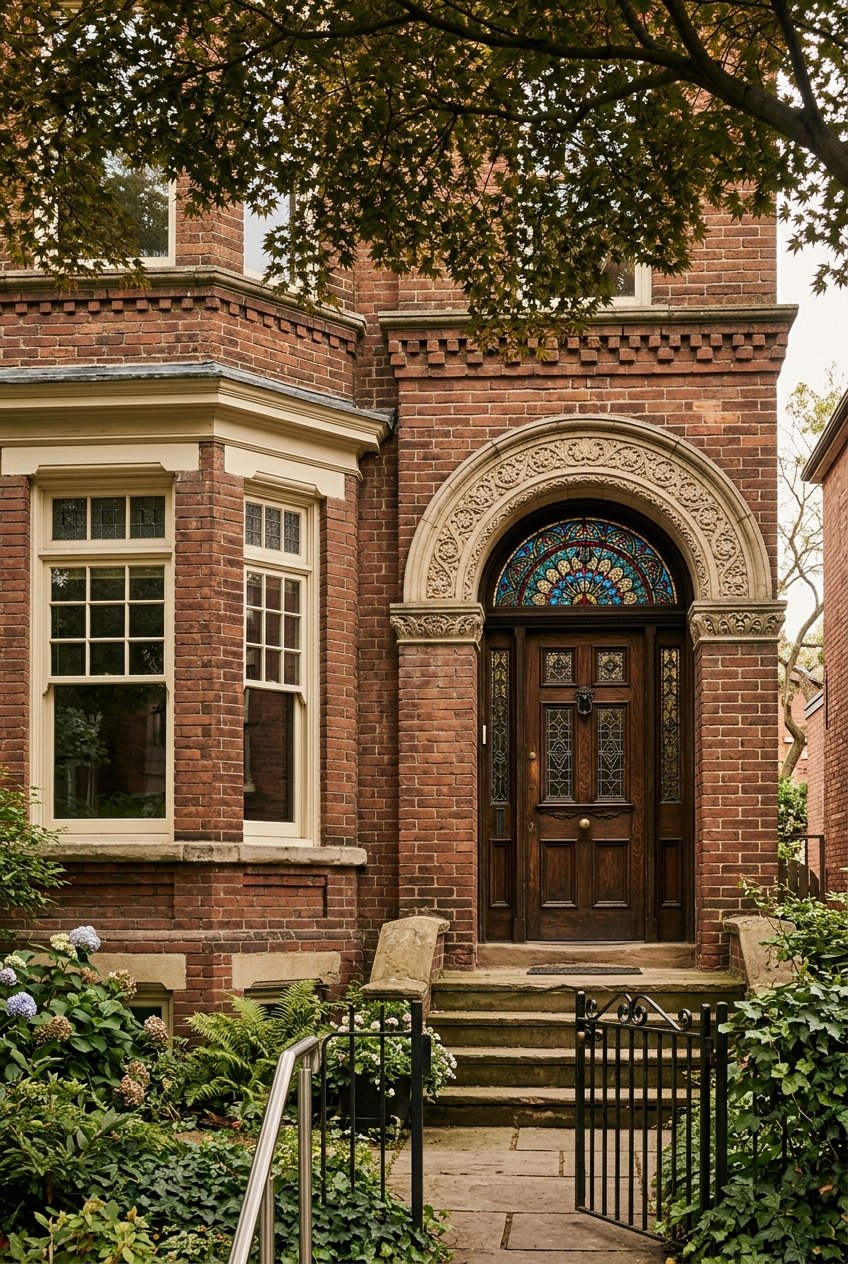
In the Annex, heritage sources describe this style through red brick, stone foundations, decorative shingles, front-facing gables, recessed entryways, rough-faced stone, rusticated masonry, and round-arched openings. If a house looks solid, deeply rooted, and almost fortress-like at its base, you are probably picking up on Romanesque influence.
This is one reason the Annex has such visual depth. Many homes balance decorative upper levels with weightier lower floors, creating façades that feel rich without looking random.
Streets where the architecture is strongest
If you want to take a more intentional walk through the neighbourhood, some streets offer a particularly strong lesson in the Annex’s early house-form architecture. The older blocks around St. George, Madison, Walmer, Huron, Lowther, and Prince Arthur are especially useful places to look closely.
Local heritage context also notes that the area developed with a range of house sizes. Grand homes were built for some of Toronto’s wealthiest families, while the east side included smaller houses for businesspeople and service professionals. Today, that historic variety still shapes how the neighbourhood reads from block to block.
What makes the walk interesting is contrast. You are not seeing one repeating house type. You are seeing a shared design vocabulary expressed at different scales.
Apartments and adaptation matter too
A common mistake is to think the Annex story is only about large old houses. In reality, apartment buildings are also part of the neighbourhood’s architectural identity.
The City identifies Spadina Gardens as one of Toronto’s first apartment buildings, and city materials note that the mid-20th century brought more apartment construction along with the reuse or replacement of many former houses. That means the Annex tells a broader story about how Toronto grew and adapted over time.
For you as a buyer or seller, this matters because the neighbourhood’s value is tied to both preservation and evolution. The appeal is not only historic charm. It is also the way heritage buildings and later forms coexist within a walkable, established setting.
How architecture shapes daily living
Architectural character in the Annex is not just visual. Many of the features people love also affect how a home feels and functions day to day.
Toronto museum materials note that bay windows improve sightlines and verandas soften the boundary between inside and outside. In Annex houses, recessed entries and sleeping porches also create sheltered transition spaces between the sidewalk and the home.
Those details can make older homes feel unusually connected to the street while still offering privacy. They also help explain why certain properties feel warm and inviting the moment you arrive, even before you step inside.
At the same time, interiors can vary more than exteriors suggest. Because many homes were later divided into rooming houses or multi-unit dwellings, similar façades may hide very different room flow, stair placement, and levels of original material.
What buyers should keep in mind
If you are buying in the Annex, curb appeal tells only part of the story. Two homes that look similar from the sidewalk can differ significantly once you get inside.
A careful review should include:
- How the interior layout has changed over time
- Whether original fabric appears intact or partially removed
- The condition of masonry, trim, and roof details
- Whether additions feel heritage-sensitive
- The property’s heritage status
The final point is especially important. The City of Toronto says designated properties require a heritage permit before changes, and properties within heritage conservation districts are reviewed through the building-permit process when alterations or demolition are proposed.
That does not make ownership harder by definition. It simply means due diligence is essential, especially if you are planning future work.
What sellers can highlight
If you are selling an Annex property, architectural details are not background decoration. They are part of the value story.
Original masonry, preserved trim, intact roof details, and thoughtful additions all help buyers understand what is special about a home. In a neighbourhood where visual identity is closely tied to late-Victorian fabric, careful presentation can make the difference between a listing that feels generic and one that feels irreplaceable.
That is also where strong marketing matters. Professional photography, video, and well-crafted listing storytelling can help buyers see not just finishes, but proportion, craftsmanship, and how a home fits into the wider streetscape.
Character and upkeep often rise together
The same features that make Annex homes memorable can also bring more maintenance than a simpler modern exterior. Complex rooflines, masonry, stone sills, turrets, and wood detailing are part of the charm, but they can also require more attention over time.
For many buyers, that tradeoff is worth it. The practical takeaway is simple: in the Annex, character and upkeep often rise together. Understanding that early helps you buy with clearer expectations and sell with a more credible narrative.
Why heritage status matters
In the Annex, heritage status is not an abstract planning term. It is a real part of how parts of the neighbourhood are managed and altered.
Sections of the area are already protected through the East Annex Heritage Conservation District and West Annex Phase I on Madison Avenue. Because of that, one of the most important questions for any buyer or seller is whether a property is individually designated, located within a heritage conservation district, or only listed on the Heritage Register.
That distinction can shape renovation timelines, approval requirements, and how you position the home in the market. It is also one reason local expertise matters so much in this neighbourhood.
If you are thinking about buying or selling in the Annex, working with an advisor who understands architectural character, heritage context, and presentation strategy can help you make better decisions at every step. To discuss the neighbourhood with a design-aware, client-first approach, connect with Jason DeLuca.
FAQs
What architectural style is most common in the Annex?
- The Annex is known for a local hybrid often called the “Annex style,” which combines Queen Anne Revival and Richardsonian Romanesque features.
What streets in the Annex show the strongest historic architecture?
- Older blocks around St. George, Madison, Walmer, Huron, Lowther, and Prince Arthur have some of the strongest concentrations of early house-form architecture.
What Queen Anne features should you look for in Annex houses?
- Common Queen Anne cues include complex rooflines, gables, dormers, chimneys, turrets, sleeping porches, tiled gables, and irregular façades.
What Romanesque details appear in Annex homes?
- Romanesque features in the Annex often include red brick, rough-faced stone, rusticated masonry, round-arched openings, front-facing gables, and recessed entryways.
What should buyers check before purchasing a heritage property in the Annex?
- Buyers should confirm whether the property is designated, located in a heritage conservation district, or listed on the Heritage Register, since those categories can affect approvals for future changes.
Why do Annex homes vary so much inside?
- Many houses were adapted over time into rooming houses or multi-unit dwellings, so interior layouts, stair placement, and original features can differ significantly even when exteriors look similar.